TRANSLATE THIS PAGE INTO ANY LANGUAGE
MEMORIAL DAY
Remembering those who gave
so much of themselves for all of us.
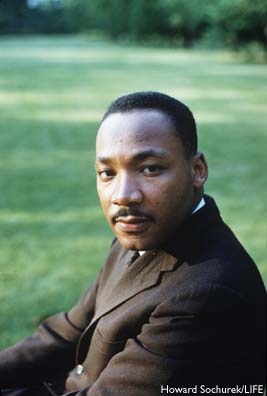
Martin Luther King
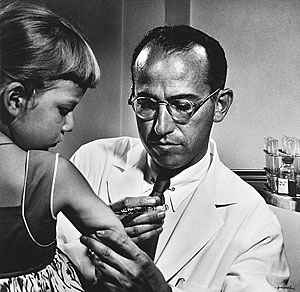
Jonas Salk
1914 - 1995
Jonas Salk is among the most
venerated medical scientists
of the century.
Though his first words were reported
to be "dirt, dirt," his early
thoughts were not on studying germs
but on going into law.
He became interested in biology
and chemistry, however,
and decided to go into research.
He went to New York University
medical school for training.
There in 1938 he began working
with microbiologist
Thomas Francis, Jr.,
who was looking for an influenza vaccine.
They developed one that was used in
the armed forces
during World War II.
In 1947 Salk became the head of the
Virus Research Lab
at the University of Pittsburgh.
He worked on improving the
flu vaccine and began to study
poliovirus with hopes of creating
a vaccine against that disease, as well.
Salk applied findings from many
other scientists to this problem.
From some he found a way to produce
large quantities of the virus;
from others a way to kill the virus
with formaldehyde so
that it remained intact enough
to cause a response in humans.
In 1952 he first inoculated volunteers,
including himself, his wife,
and their three sons, with a
polio vaccine made from this killed virus.
Everyone who received the test vaccine
began producing
antibodies to the disease,
yet no one became ill.
The vaccine seemed safe and effective.
The following year he published
the results in the
Journal of the American Medical Association,
and nationwide
testing was carried out.
Since the turn of the century,
polio outbreaks had grown more
frequent and more devastating.
In 1952, some estimates recorded 57,628 cases,
making it the
worst year yet.
People were very anxious for a breakthrough
against polio.
Salk's former mentor Thomas Francis, Jr.,
directed the mass
vaccination of schoolchildren.
Salk's vaccine was soon replaced by
a variation developed
by Albert Sabin that
could be taken orally.
There were pros and cons to each,
but the oral vaccination won out.
In 1963, still somewhat alienated from
the medical community,
Salk founded the
Salk Institute for Biological Sciences in
La Jolla, California.
"I couldn't possibly have become a
member of this institute if I
hadn't founded it myself," he said.
Jonas Salk died of congestive
heart failure in 1995.
From People and Discoveries: CLICK HERE
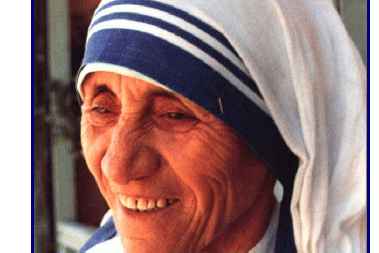
Mother Teresa
1910 - 1997
Mother Teresa, winner of the
Nobel Peace Prize, died in
her convent in India.
She was 87.
Born Agnes Gonxha Bojaxhiu in 1910
in Skopje, Yugoslavia,
she joined the Sisters of Loreto in 1928.
She took the name "Teresa" after
St. Teresa of Lesiux,
patroness of the Missionaries.
In 1948, she came across a half-dead
woman lying in front of
a Calcutta hospital.
She stayed with the woman until she died.
From that point on,
she dedicated the majority of her life to
helping the poorest of the poor in India,
thus gaining her the name
"Saint of the Gutters."
She founded an order of nuns called the
Missionaries of Charity
in Calcutta, India
dedicated to serving the poor.
Almost 50 years later, the
Missionaries of Charity have grown from
12 sisters in India to over 3,000 in
517 missions throughout
100 countries worldwide.
Martin Luther King 1929-1968
At the age of thirty-five,
Martin Luther King, Jr.,
was the youngest
man to have received the
Nobel Peace Prize.
When notified of his selection,
he announced that he would turn
over the prize money of $54,123 to
the furtherance of the civil rights movement.
In 1957 he was elected president of the
Southern Christian Leadership Conference,
an organization formed to provide
new leadership for the now burgeoning
civil rights movement.
The ideals for this organization
he took from Christianity;
its operational techniques from Gandhi.
In the eleven-year period between
1957 and 1968, King traveled over
six million miles and spoke
over twenty-five hundred times,
appearing wherever there was injustice,
protest, and action; and
meanwhile he wrote five books
as well as numerous articles.
In these years, he led a massive protest
in Birmingham, Alabama,
that caught the attention of
the entire world, providing what he called a
coalition of conscience.
and inspiring his
"Letter from a Birmingham Jail",
a manifesto of the Negro revolution.
He planned the drives in Alabama
for the registration of Negroes as voters;
he directed the peaceful march on
Washington, D.C., of 250,000 people to
whom he delivered his address,
"l Have a Dream".
He conferred with
President John F. Kennedy
and campaigned for
President Lyndon B. Johnson.
He was arrested upwards of
twenty times and assaulted at least four times;
he was awarded five honorary degrees;
was named Man of the Year by
Time magazine in 1963;
and became not only the symbolic leader
of American blacks but also a world figure.
On the evening of April 4, 1968,
while standing on the balcony of
his motel room in Memphis, Tennessee,
where he was to lead a
protest march in sympathy
with striking garbage workers of that city,
he was assassinated.
TO RETURN TO THE HIDDEN MEANINGS HOME PAGE